
Highway Murders 1988-1989 Victims: 9
Three decades ago, the largest criminal investigation in the region was underway. Eleven (11) women had disappeared between April and September 1988. During the months of July 1988 and April 1989 the bodies of nine (9) of the eleven (11) missing women were being discovered along local highways. The remaining missing two (2) women have never been found, they are presumed dead.
None of the victims were actually found in New Bedford, yet the case became known as the New Bedford Highway Killings.
The first person who noticed similarities in the backgrounds of young women was New Bedford Police Detective John Dextrader.
Robbin "Bobby Lyn" Rhodes, 28, Victim #1
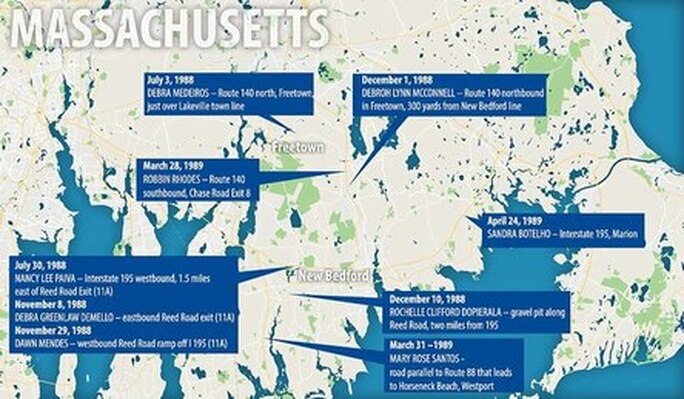
Ms. Rhodes was last seen in New Bedford in April 1988 by her mother. Her remains were discovered on March 28 1989 along Route 140 southbound in Freetown by a Connecticut State Police K-9. Her remains were positively identified in April 1989. She was drug dependent, but never involved prostitution and was friends with several of the other victims.
Rochelle Clifford Dopierala, 28, Victim #2
Ms. Dopierala was last seen in New Bedford, April 1988. Her remains were discovered on December 10 1988 in a gravel pit off Reed Road in Dartmouth, about 2 miles from Route 195, by hunters riding ATVs. Her partially clothed remains were positively identified in December 1988. Rochelle had been a witness in a case against a man named Roger Swire who allegedly raped her and was being charged with weapons charges. She was last seen with Nancy Paiva’s boyfriend, an ex-convict. He was cleared in both deaths.
Debroh Lynn McConnell, 25, Victim #3
Ms. McConnell was last seen in New Bedford in May 1988 by her father at a cemetery after they had buried her mother. Her remains were discovered on December 1 1988 along Route 140 northbound in Freetown by a Connecticut State Police K-9. Her remains were positively identified in March 1989.
Debra Medeiros, 30, Victim #4
Ms. Medeiros was last seen in New Bedford on May 27,1988 after ending a relationship with her boyfriend. Her remains were discovered on July 3, 1988 approximately 30 feet off Route 140 northbound in Freetown by a motorist making a pit stop. The severely decomposed remains were partially clothed, a bra around its neck. It was determined the remains had been there for a few months. Her remains were positively identified in December 1988. Debra was known to law enforcement for long standing substance abuse issues but no record of prostitution.
Nancy Paiva, 36, Victim #5
Ms. Paiva was last seen in New Bedford on July 7 1988 after walking out of "Whisper's Pub" in the South End of New Bedford after having an argument with her boyfriend. She was reported missing to New Bedford Police. Her remains were discovered on July 30 1988 off the eastbound Reed Road exit ramp to Route 195 in Dartmouth, by two men on motorcycles. Her remains were positively identified in December 1988.
She had no involvement in prostitution, but had a history of substance abuse. She was in a very difficult domestic violence situation with a heroin dealer named Frankie Pina. Detectives took the case seriously when her boyfriend, the dealer, reported her missing. Police knew him well as he had had many run-ins with the police involving drugs and domestic violence.
Deborah DeMello Greenlaw, 35, Victim #6
Ms. Greenlaw was last seen in New Bedford on July 11 1988. Her remains were discovered on November 8 1988 along Route 195 1.5 miles east of the Reed Road exit in Dartmouth by a highway crew. Her remains were positively identified in December 1988.
She had walked away from a prison work-release program in Rhode Island on June 18, 1988 after charges for prostitution and had a history of substance abuse. Her remains were concealed by trees and her clothes were strewn in the nearby tree branches. She was found with some belongings of Nancy Paiva.
Mary Rose Santos, 26, Victim #7
Ms. Santos was last seen in New Bedford on July 16 1988 dancing at the Old Quarterdeck Lounge in the early morning hours. Her remains were discovered on March 31 1989 along Route 88 in Westport. Her remains were positively identified in April 1989
Her husband had dropped her off earlier near the downtown bus station and witnesses say she had planned to walk to a friend’s apartment nearby before she went missing. Santos was known to have struggle with substance abuse.
A mysterious anonymous letter reached District Attorney Pina on March 16 1989, telling him that investigators might find a body along Route 88. If a body was found, the author said he might come forward. After two boys found Santos’ body, the informant allegedly contacted authorities.
At the time DA spokesperson Jim Martin said ″He (an informant) witnessed an event taking place along Route 88 and this person is providing us with some good information and we need to protect this person.″ Martin added that he did not wish to say whether the informant was male or female. It was reported by Martin that the DA's office Investigators had met with the informant in secret and at various locations to maintain the informant’s anonymity. The letter was never seen by investigators and Martin has no recollection of this letter. The letter and was never presented as evidence to this day has never been found.
Sandra Botelho, 24, Victim #8
Ms. Botelho was last seen in New Bedford on August 11 1988 after leaving her apartment. Her remains were discovered on April 24 1989 along Route 195 in Marion by a highway work crew. Her remains were positively identified in April 1989. She was a known to be involved in prostitution and substance abuse.
Dawn Mendes, 25, Victim #9
Ms. Mendes was last seen in New Bedford on September 4 1988 walking from her South End apartment to a family christening party. Her remains were discovered on November 29, 1988 along Route 195 westbound ramp to Reed Road in Dartmouth by a Connecticut State Police K-9. She had a history of prostitution and substance abuse.
Christine Monteiro, 19, Presumed Victim #10 Missing
Ms. Monteiro was last seen in New Bedford in May 1988 wearing a shirt, blue jeans and sneakers. She was known to have substance abuse issues. She has never been located and remains missing. She was the step-daughter of a deceased Dartmouth Police officer. She was known to have substance abuse issues.
Marilyn Roberts, 34, Presumed Victim #11 Missing
Ms. Roberts was last seen in New Bedford June 1988. She was known to have substance abuse issues. Family thought she had moved to the West Coast to live with a relative. In December 1988 her family reported her missing. She has never been located and remains missing.
She was the daughter of a retired New Bedford Police officer.
Characters of Interest:
Franklin J. Pina
The Highway Killing Case started with Franklin Pina reporting his girlfriend missing to New Bedford Police Department. Pina had resided with Nancy Paiva (#5) and Rochelle Clifford Dopierala (#2). Pina was the last person to see Rochelle alive on April 27 1988, and he was with Nancy Paiva before she went missing on July 7 1988. Pina was incarcerated in July 1988 on unrelated crimes when Sandra Bothelo (#8) went missing on August 11 1988.
There is no evidence supporting Pina was involved in the case. The one and only law enforcement official to interview Pina was Detective Dextradeur from New Bedford Police Department, who retired during the highway killing investigation. Pina was interviewed by the Grand Jury but testimony indicated he was only questioned about Kenneth Ponte. Franklin Pina is and was the most important witness in this case.
September 25, 2019 Franklin J. Pina, now 68 was arrested during a traffic stop at about 12:00pm in Dennis. Pina was taken into custody after officers located material believed to be cocaine inside the vehicle. Pina was arrested and charged with Possession with Intent to Distribute Class B, Subsequent Offense, Trafficking a Class B substance and Conspiracy to Violate Drug Laws. Immediately after his arrest, a search warrant was executed at a motel in Orleans, along with two additional search warrants were also executed in Eastham. During the searches, a firearm, along with other items, including a scale, a cutting agent, money and cellphones were seized. Pina has been arraigned in Orleans District Court and is currently being held on $10,000 cash. Further charges may be pending as this investigation is still ongoing.
Attorney Kenneth Ponte (Deceased 2010)
New Bedford Attorney Kenneth Ponte was a local boy who had received a pardon for a drug-possession arrest and then became a lawyer. Ponte was known for his substance abuse and his connections to three (3) of the victims, all of which he represented in court proceedings. Ponte also had a relationship with Rochelle Dopierala (#2) for a short period of time. On April 3 1998 Ponte was involved, producing a firearm, during an altercation with a male who Dopierla claimed had raped her.
On October 10 1988 Ponte closed his law office and moved to Port Richey Florida. Although this raised suspicions with law enforcement, it was determined he’d talked about moving to Florida for a year.
On January 18 1989 Ponte returned to New Bedford Superior Court after a grand jury indicted him on the gun charge from April 1988.
On August 17 1990 Ponte was arraigned on one (1) count of murder (Rochelle Dopierla) after being indicted by a grand jury investigating the Highway Killings. The indictment accused Ponte of beating Rochelle Dopierla to death on April 27, 1988. Ponte entered a not guilty plea and was released on $500,000 bond. District Attorney Pina suggested Ponte killed Dopierla because she was allegedly planning on exposing Pontes drug activities.
On July 29, 1991 The DA's Office announced the murder charges against Ponte were dismissed due to lack of evidence. A theory, swirled around the possibility the murders were connected to the production of snuff films. It was rumored that one (or several) of the victims were involved in the casting. This theory was dismissed by investigators, since no evidence could support the theory. Hundreds of videos were recovered from the home of Kenneth Ponte, none of these films contained and of the victims or were produced locally.
In May 1997 Ponte was disbarred for using $12,000 of a clients insurance settlement for personal use. On May 15, 2009 law enforcement obtained a search warrant for Pontes former home at 106 Chestnut Street, which was taken in foreclosure by the bank. The warrant was for the driveway and a concrete slab patio. The patio was poured around the time the women began to disappear. It was rumored Christine Monteiro was buried under the patio, no evidence was discovered. The excavation was publicized and ignited rage among some victims’ family members who viewed it as a publicity stunt.
In May 2007, Ponte was arrested for shoplifting four cans of sardines and a block of cheese from the local Price Rite. A month earlier, an affidavit filed by his sister alleged that he’d threatened to kill his mother, his sister and himself in a fight over money.
On January 26, 2010 Ponte was found dead at his home at 366 Austin Street. The cause of death was ruled natural causes, although significant drug paraphernalia was discovered along with the body.
Anthony DeGrazia “Flat Nose” (Deceased 1991)
Anthony DeGrazia (29) was known to frequent the services of prostitutes. In May 1989, DeGrazia was charged with four counts of rape, six counts of assault and battery, and one count of assault with intent to rape, charges stemming from attacks on prostitutes during the same timeframe.
DeGrazia was held on $180,000.00 dollars and a one million dollar surety bond. DeGrazia not being able to reach this bail would spend the next 13 months in the county jail on these allegations brought against him by the District Attorney Ronald Pina. DeGrazia would have 18 court appearances during his 13 months of incarceration in the county jail. DeGrazia's Defense Attorney filed 18 motions before the court for the production documents of evidence including a request for a bail reduction because of the lack of evidence being produced against DeGrazia by the District Attorney's office. Each motion was continually denied by the presiding Judge. Finally DeGrazia fired Harrington and hired a Boston Attorney by the name of Robert A. George Esq. Attorney George filed a contempt on the District Attorney's office for non production of evidence and the Judge had no choice but to lower DeGrazia's bail. DeGrazia was finally released from jail on June 27, 1990. Immediately after DeGrazia was released on bail he was rearrested for allegedly uttering threats to the DA Ronald Pina for wrongful prosecution and imprisonment. DeGrazia again posted bond, and was re released. DeGrazia was interviewed by the grand jury but was never charged.
On July 27,1991 Anthony DeGrazia was found dead outside his ex-girlfriends home in Freetown. His death was ruled a homicide by Freetown Police who first arrived on the scene. However, the District Attorney's Office later ruled his death a suicide. The autopsy report rules DeGrazia's death a homicide. Authorities are quick to state in a public broadcast that it was a timely thing that DeGrazia took his own life after being made aware that he was now being considered the prime suspect in connection to the New Bedford Highway Killings Case. Later this statement made against DeGrazia by the states Special Prosecutor Paul Buckley was retracted by the D.A's office.
No evidence was ever found linking Anthony DeGrazia to any of the rapes or assaults he was charged with, nor has there been any evidence produced by the District Attorney's office connecting Anthony DeGrazia to the Highway Killings.
Neil Anderson (Deceased 2021)
Neil Anderson caught the eyes of investigators, but was quickly dismissed. He was identified as being involved with assaulting and raping prostitutes from Weld Square area during the Highway Killings. Anderson lived near the Weld Square area at the time and was known to police.
He was charged with rape and intent to rape for an incident on Copicut Road In Dartmouth. He was indicted in an additional rape that took place in the Reservation in Fall River. He was interviewed by the grand jury, but interest in him waned off.
Anderson was convicted in 1994 for aggravated rape, and completing his sentence was held at the Massachusetts Treatment Center in Bridgewater for a year while prosecutors attempted to tried to convince the court he was sexually dangerous. The court released him on September 20 2006.
On August 16 2007 he is accused of robbing the North Easton Savings Bank in Easton and on September 6 2007 robbing the Slade Bank in Swansea. Anderson is also a suspect in the robberies of banks in Raynham, North Attleboro, and East Providence, R.I.
Neil Anderson died in May 2021 of a drug overdose.
Louis DeSousa
DeSousa, was convicted and deported to Portugal in 2010 after a 1989 vicious attack and rape with a pipe and bottle at Fort Taber in New Bedford. He was never interviewed by the Grand Jury, nor was a DNA sample taken
James Baker (Deceased 2007)
A resident of Tiverton, was briefly investigated, did testify in front of the Grand Jury. He passed a polygraph exam and was dismissed as a suspect. He died in 2007 in Florida.
Politics and the District Attorney's Office
The largest criminal investigation in the region was underway and DA Ronald Pina was attempting to solve the case. Political pressure was mounting to solve the case with no results, in 1990 Pina lost re-election and Paul Walsh Jr. was elected. Walsh also publicly committed to solve the case, and on March 7, 1991 appointed Paul Buckley as special prosecutor. On July 29, 1991 the murder charge against Ponte was dropped due to lack of evidence by the special prosecutor. The case went cold. Walsh and two of the original investigators believed DeGrazia was the Highway Killer, and by taking his own life, it was an admission of guilt. In 2006 Samuel Sutter was elected District Attorney, he committed to solving cold cases within Bristol County. Many cases were solved, but not the Highway Killings. Sutter was not convinced that DeGrazia was the killer and felt the evidence doesn't point to that person.
In 2014 Sutter resigned and was elected Mayor of the City of Fall River. Thomas Quinn was appointed District Attorney and remains in office today.
Abduction of Sheila Martines-Pina (1956-2014)
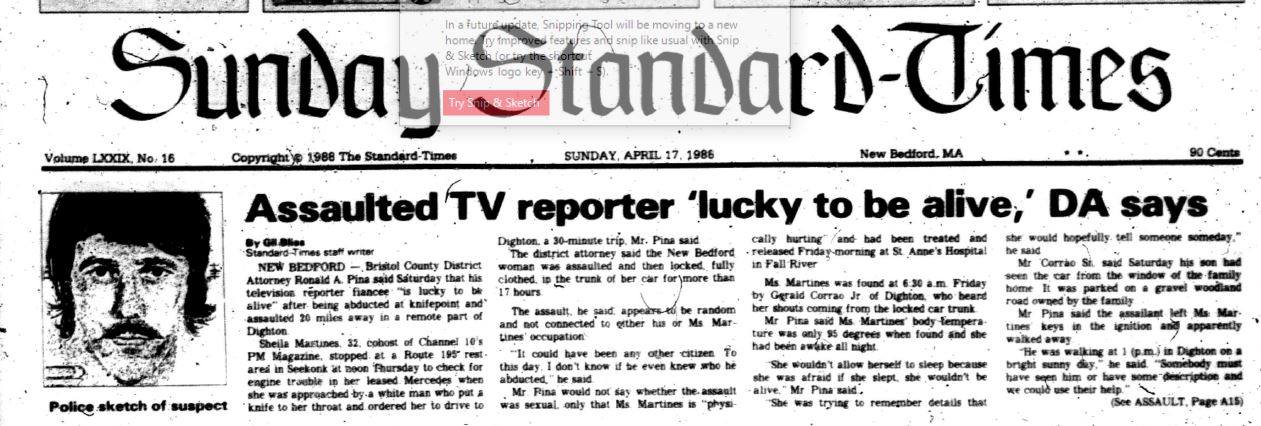
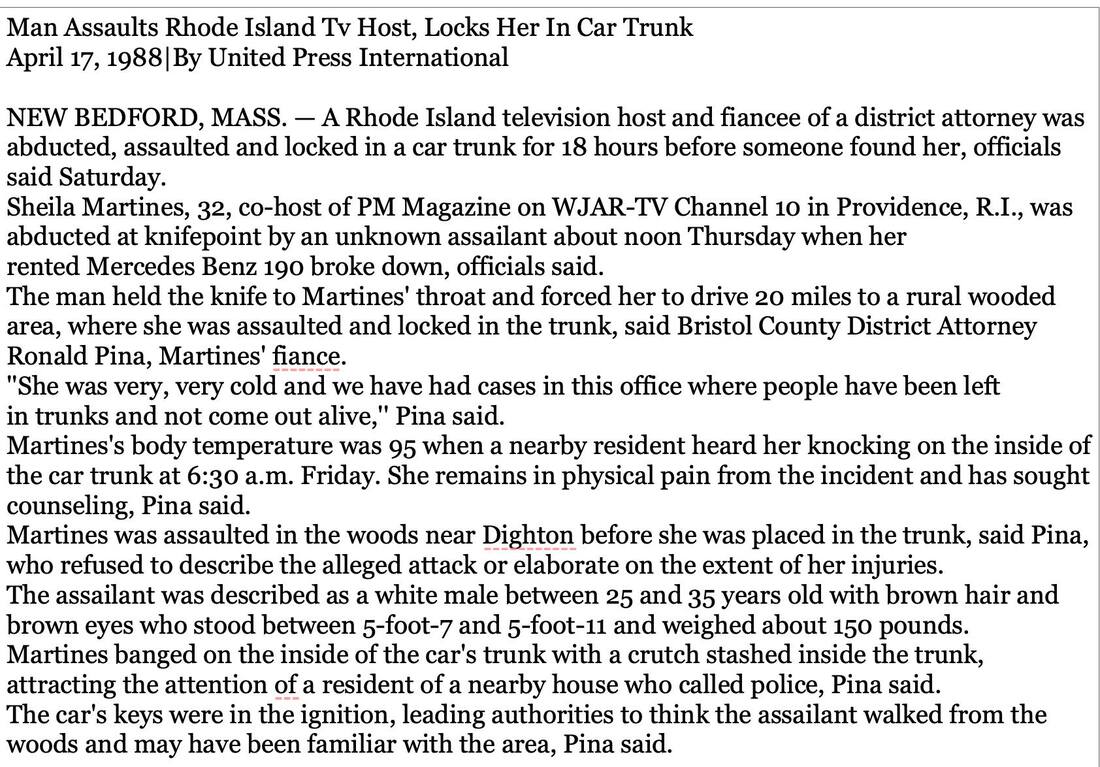
On April 16 1988 the fiancée of District Attorney Ron Pina was reportedly abducted, assaulted and locked in the trunk of her own vehicle for 18 hours in Dighton.
According to her, she was abducted at knife point by an unknown assailant around noon when her vehicle was disabled in the rest area on Route 195 in Seekonk. She reported the man held a knife to her throat and forced her to drive 20 miles to a secluded section of Dighton, where she claims she was assaulted and locked in the trunk of her vehicle. Her vehicle was discovered by a resident in the neighborhood who heard her banging the inside of the trunk and called police. She refused to describe the attack or elaborate on the extent of her injuries to law enforcement.
The keys were still in the ignition, leading authorities to think the assailant walked away from the woods and may have been familiar with the area. All police reports on this incident have been sealed. No arrests were made in the case.
Three decades ago, the largest criminal investigation in the region was underway. Eleven (11) women had disappeared between April and September 1988. During the months of July 1988 and April 1989 the bodies of nine (9) of the eleven (11) missing women were being discovered along local highways. The remaining missing two (2) women have never been found, they are presumed dead.
None of the victims were actually found in New Bedford, yet the case became known as the New Bedford Highway Killings.
The first person who noticed similarities in the backgrounds of young women was New Bedford Police Detective John Dextrader.
Robbin "Bobby Lyn" Rhodes, 28, Victim #1
Ms. Rhodes was last seen in New Bedford in April 1988 by her mother. Her remains were discovered on March 28 1989 along Route 140 southbound in Freetown by a Connecticut State Police K-9. Her remains were positively identified in April 1989. She was drug dependent, but never involved prostitution and was friends with several of the other victims.
Rochelle Clifford Dopierala, 28, Victim #2
Ms. Dopierala was last seen in New Bedford, April 1988. Her remains were discovered on December 10 1988 in a gravel pit off Reed Road in Dartmouth, about 2 miles from Route 195, by hunters riding ATVs. Her partially clothed remains were positively identified in December 1988. Rochelle had been a witness in a case against a man named Roger Swire who allegedly raped her and was being charged with weapons charges. She was last seen with Nancy Paiva’s boyfriend, an ex-convict. He was cleared in both deaths.
Debroh Lynn McConnell, 25, Victim #3
Ms. McConnell was last seen in New Bedford in May 1988 by her father at a cemetery after they had buried her mother. Her remains were discovered on December 1 1988 along Route 140 northbound in Freetown by a Connecticut State Police K-9. Her remains were positively identified in March 1989.
Debra Medeiros, 30, Victim #4
Ms. Medeiros was last seen in New Bedford on May 27,1988 after ending a relationship with her boyfriend. Her remains were discovered on July 3, 1988 approximately 30 feet off Route 140 northbound in Freetown by a motorist making a pit stop. The severely decomposed remains were partially clothed, a bra around its neck. It was determined the remains had been there for a few months. Her remains were positively identified in December 1988. Debra was known to law enforcement for long standing substance abuse issues but no record of prostitution.
Nancy Paiva, 36, Victim #5
Ms. Paiva was last seen in New Bedford on July 7 1988 after walking out of "Whisper's Pub" in the South End of New Bedford after having an argument with her boyfriend. She was reported missing to New Bedford Police. Her remains were discovered on July 30 1988 off the eastbound Reed Road exit ramp to Route 195 in Dartmouth, by two men on motorcycles. Her remains were positively identified in December 1988.
She had no involvement in prostitution, but had a history of substance abuse. She was in a very difficult domestic violence situation with a heroin dealer named Frankie Pina. Detectives took the case seriously when her boyfriend, the dealer, reported her missing. Police knew him well as he had had many run-ins with the police involving drugs and domestic violence.
Deborah DeMello Greenlaw, 35, Victim #6
Ms. Greenlaw was last seen in New Bedford on July 11 1988. Her remains were discovered on November 8 1988 along Route 195 1.5 miles east of the Reed Road exit in Dartmouth by a highway crew. Her remains were positively identified in December 1988.
She had walked away from a prison work-release program in Rhode Island on June 18, 1988 after charges for prostitution and had a history of substance abuse. Her remains were concealed by trees and her clothes were strewn in the nearby tree branches. She was found with some belongings of Nancy Paiva.
Mary Rose Santos, 26, Victim #7
Ms. Santos was last seen in New Bedford on July 16 1988 dancing at the Old Quarterdeck Lounge in the early morning hours. Her remains were discovered on March 31 1989 along Route 88 in Westport. Her remains were positively identified in April 1989
Her husband had dropped her off earlier near the downtown bus station and witnesses say she had planned to walk to a friend’s apartment nearby before she went missing. Santos was known to have struggle with substance abuse.
A mysterious anonymous letter reached District Attorney Pina on March 16 1989, telling him that investigators might find a body along Route 88. If a body was found, the author said he might come forward. After two boys found Santos’ body, the informant allegedly contacted authorities.
At the time DA spokesperson Jim Martin said ″He (an informant) witnessed an event taking place along Route 88 and this person is providing us with some good information and we need to protect this person.″ Martin added that he did not wish to say whether the informant was male or female. It was reported by Martin that the DA's office Investigators had met with the informant in secret and at various locations to maintain the informant’s anonymity. The letter was never seen by investigators and Martin has no recollection of this letter. The letter and was never presented as evidence to this day has never been found.
Sandra Botelho, 24, Victim #8
Ms. Botelho was last seen in New Bedford on August 11 1988 after leaving her apartment. Her remains were discovered on April 24 1989 along Route 195 in Marion by a highway work crew. Her remains were positively identified in April 1989. She was a known to be involved in prostitution and substance abuse.
Dawn Mendes, 25, Victim #9
Ms. Mendes was last seen in New Bedford on September 4 1988 walking from her South End apartment to a family christening party. Her remains were discovered on November 29, 1988 along Route 195 westbound ramp to Reed Road in Dartmouth by a Connecticut State Police K-9. She had a history of prostitution and substance abuse.
Christine Monteiro, 19, Presumed Victim #10 Missing
Ms. Monteiro was last seen in New Bedford in May 1988 wearing a shirt, blue jeans and sneakers. She was known to have substance abuse issues. She has never been located and remains missing. She was the step-daughter of a deceased Dartmouth Police officer. She was known to have substance abuse issues.
Marilyn Roberts, 34, Presumed Victim #11 Missing
Ms. Roberts was last seen in New Bedford June 1988. She was known to have substance abuse issues. Family thought she had moved to the West Coast to live with a relative. In December 1988 her family reported her missing. She has never been located and remains missing.
She was the daughter of a retired New Bedford Police officer.
Characters of Interest:
Franklin J. Pina
The Highway Killing Case started with Franklin Pina reporting his girlfriend missing to New Bedford Police Department. Pina had resided with Nancy Paiva (#5) and Rochelle Clifford Dopierala (#2). Pina was the last person to see Rochelle alive on April 27 1988, and he was with Nancy Paiva before she went missing on July 7 1988. Pina was incarcerated in July 1988 on unrelated crimes when Sandra Bothelo (#8) went missing on August 11 1988.
There is no evidence supporting Pina was involved in the case. The one and only law enforcement official to interview Pina was Detective Dextradeur from New Bedford Police Department, who retired during the highway killing investigation. Pina was interviewed by the Grand Jury but testimony indicated he was only questioned about Kenneth Ponte. Franklin Pina is and was the most important witness in this case.
September 25, 2019 Franklin J. Pina, now 68 was arrested during a traffic stop at about 12:00pm in Dennis. Pina was taken into custody after officers located material believed to be cocaine inside the vehicle. Pina was arrested and charged with Possession with Intent to Distribute Class B, Subsequent Offense, Trafficking a Class B substance and Conspiracy to Violate Drug Laws. Immediately after his arrest, a search warrant was executed at a motel in Orleans, along with two additional search warrants were also executed in Eastham. During the searches, a firearm, along with other items, including a scale, a cutting agent, money and cellphones were seized. Pina has been arraigned in Orleans District Court and is currently being held on $10,000 cash. Further charges may be pending as this investigation is still ongoing.
Attorney Kenneth Ponte (Deceased 2010)
New Bedford Attorney Kenneth Ponte was a local boy who had received a pardon for a drug-possession arrest and then became a lawyer. Ponte was known for his substance abuse and his connections to three (3) of the victims, all of which he represented in court proceedings. Ponte also had a relationship with Rochelle Dopierala (#2) for a short period of time. On April 3 1998 Ponte was involved, producing a firearm, during an altercation with a male who Dopierla claimed had raped her.
On October 10 1988 Ponte closed his law office and moved to Port Richey Florida. Although this raised suspicions with law enforcement, it was determined he’d talked about moving to Florida for a year.
On January 18 1989 Ponte returned to New Bedford Superior Court after a grand jury indicted him on the gun charge from April 1988.
On August 17 1990 Ponte was arraigned on one (1) count of murder (Rochelle Dopierla) after being indicted by a grand jury investigating the Highway Killings. The indictment accused Ponte of beating Rochelle Dopierla to death on April 27, 1988. Ponte entered a not guilty plea and was released on $500,000 bond. District Attorney Pina suggested Ponte killed Dopierla because she was allegedly planning on exposing Pontes drug activities.
On July 29, 1991 The DA's Office announced the murder charges against Ponte were dismissed due to lack of evidence. A theory, swirled around the possibility the murders were connected to the production of snuff films. It was rumored that one (or several) of the victims were involved in the casting. This theory was dismissed by investigators, since no evidence could support the theory. Hundreds of videos were recovered from the home of Kenneth Ponte, none of these films contained and of the victims or were produced locally.
In May 1997 Ponte was disbarred for using $12,000 of a clients insurance settlement for personal use. On May 15, 2009 law enforcement obtained a search warrant for Pontes former home at 106 Chestnut Street, which was taken in foreclosure by the bank. The warrant was for the driveway and a concrete slab patio. The patio was poured around the time the women began to disappear. It was rumored Christine Monteiro was buried under the patio, no evidence was discovered. The excavation was publicized and ignited rage among some victims’ family members who viewed it as a publicity stunt.
In May 2007, Ponte was arrested for shoplifting four cans of sardines and a block of cheese from the local Price Rite. A month earlier, an affidavit filed by his sister alleged that he’d threatened to kill his mother, his sister and himself in a fight over money.
On January 26, 2010 Ponte was found dead at his home at 366 Austin Street. The cause of death was ruled natural causes, although significant drug paraphernalia was discovered along with the body.
Anthony DeGrazia “Flat Nose” (Deceased 1991)
Anthony DeGrazia (29) was known to frequent the services of prostitutes. In May 1989, DeGrazia was charged with four counts of rape, six counts of assault and battery, and one count of assault with intent to rape, charges stemming from attacks on prostitutes during the same timeframe.
DeGrazia was held on $180,000.00 dollars and a one million dollar surety bond. DeGrazia not being able to reach this bail would spend the next 13 months in the county jail on these allegations brought against him by the District Attorney Ronald Pina. DeGrazia would have 18 court appearances during his 13 months of incarceration in the county jail. DeGrazia's Defense Attorney filed 18 motions before the court for the production documents of evidence including a request for a bail reduction because of the lack of evidence being produced against DeGrazia by the District Attorney's office. Each motion was continually denied by the presiding Judge. Finally DeGrazia fired Harrington and hired a Boston Attorney by the name of Robert A. George Esq. Attorney George filed a contempt on the District Attorney's office for non production of evidence and the Judge had no choice but to lower DeGrazia's bail. DeGrazia was finally released from jail on June 27, 1990. Immediately after DeGrazia was released on bail he was rearrested for allegedly uttering threats to the DA Ronald Pina for wrongful prosecution and imprisonment. DeGrazia again posted bond, and was re released. DeGrazia was interviewed by the grand jury but was never charged.
On July 27,1991 Anthony DeGrazia was found dead outside his ex-girlfriends home in Freetown. His death was ruled a homicide by Freetown Police who first arrived on the scene. However, the District Attorney's Office later ruled his death a suicide. The autopsy report rules DeGrazia's death a homicide. Authorities are quick to state in a public broadcast that it was a timely thing that DeGrazia took his own life after being made aware that he was now being considered the prime suspect in connection to the New Bedford Highway Killings Case. Later this statement made against DeGrazia by the states Special Prosecutor Paul Buckley was retracted by the D.A's office.
No evidence was ever found linking Anthony DeGrazia to any of the rapes or assaults he was charged with, nor has there been any evidence produced by the District Attorney's office connecting Anthony DeGrazia to the Highway Killings.
Neil Anderson (Deceased 2021)
Neil Anderson caught the eyes of investigators, but was quickly dismissed. He was identified as being involved with assaulting and raping prostitutes from Weld Square area during the Highway Killings. Anderson lived near the Weld Square area at the time and was known to police.
He was charged with rape and intent to rape for an incident on Copicut Road In Dartmouth. He was indicted in an additional rape that took place in the Reservation in Fall River. He was interviewed by the grand jury, but interest in him waned off.
Anderson was convicted in 1994 for aggravated rape, and completing his sentence was held at the Massachusetts Treatment Center in Bridgewater for a year while prosecutors attempted to tried to convince the court he was sexually dangerous. The court released him on September 20 2006.
On August 16 2007 he is accused of robbing the North Easton Savings Bank in Easton and on September 6 2007 robbing the Slade Bank in Swansea. Anderson is also a suspect in the robberies of banks in Raynham, North Attleboro, and East Providence, R.I.
Neil Anderson died in May 2021 of a drug overdose.
Louis DeSousa
DeSousa, was convicted and deported to Portugal in 2010 after a 1989 vicious attack and rape with a pipe and bottle at Fort Taber in New Bedford. He was never interviewed by the Grand Jury, nor was a DNA sample taken
James Baker (Deceased 2007)
A resident of Tiverton, was briefly investigated, did testify in front of the Grand Jury. He passed a polygraph exam and was dismissed as a suspect. He died in 2007 in Florida.
Politics and the District Attorney's Office
The largest criminal investigation in the region was underway and DA Ronald Pina was attempting to solve the case. Political pressure was mounting to solve the case with no results, in 1990 Pina lost re-election and Paul Walsh Jr. was elected. Walsh also publicly committed to solve the case, and on March 7, 1991 appointed Paul Buckley as special prosecutor. On July 29, 1991 the murder charge against Ponte was dropped due to lack of evidence by the special prosecutor. The case went cold. Walsh and two of the original investigators believed DeGrazia was the Highway Killer, and by taking his own life, it was an admission of guilt. In 2006 Samuel Sutter was elected District Attorney, he committed to solving cold cases within Bristol County. Many cases were solved, but not the Highway Killings. Sutter was not convinced that DeGrazia was the killer and felt the evidence doesn't point to that person.
In 2014 Sutter resigned and was elected Mayor of the City of Fall River. Thomas Quinn was appointed District Attorney and remains in office today.
Abduction of Sheila Martines-Pina (1956-2014)
On April 16 1988 the fiancée of District Attorney Ron Pina was reportedly abducted, assaulted and locked in the trunk of her own vehicle for 18 hours in Dighton.
According to her, she was abducted at knife point by an unknown assailant around noon when her vehicle was disabled in the rest area on Route 195 in Seekonk. She reported the man held a knife to her throat and forced her to drive 20 miles to a secluded section of Dighton, where she claims she was assaulted and locked in the trunk of her vehicle. Her vehicle was discovered by a resident in the neighborhood who heard her banging the inside of the trunk and called police. She refused to describe the attack or elaborate on the extent of her injuries to law enforcement.
The keys were still in the ignition, leading authorities to think the assailant walked away from the woods and may have been familiar with the area. All police reports on this incident have been sealed. No arrests were made in the case.
|
|
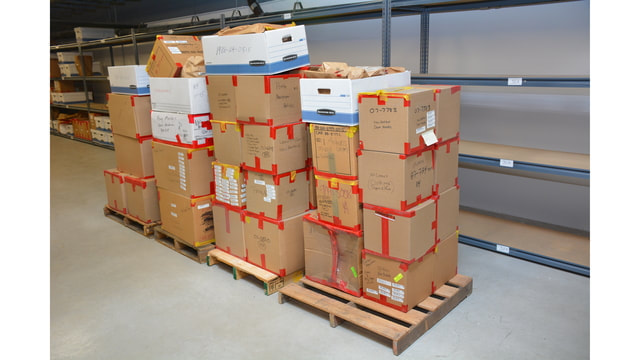
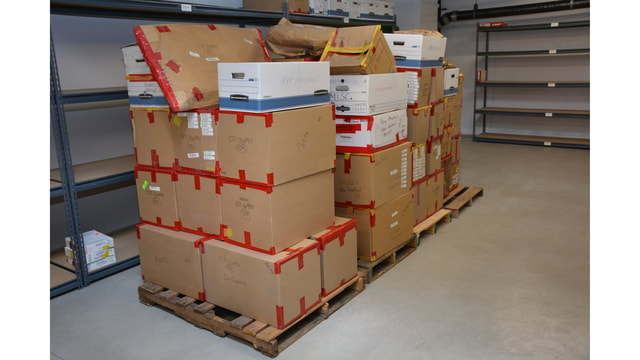
Evidence in storage from the Highway Murders
|
|

Marilyn Roberts
|
Christine Monteiro
|

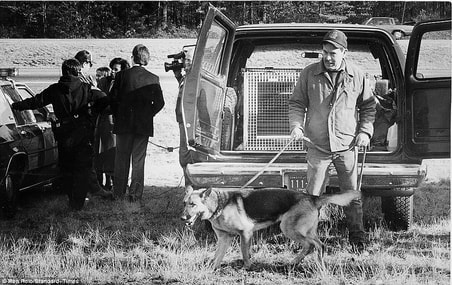
Connecticut State Police K-9
|
|
Highway Killing Case and DNA Evidence
In late 2007, the District Attorney's Office took advantage of the state police lab’s offer to re-examine forensic evidence from the case, which hadn’t been looked at for five years. His office sent four pallets worth of evidence to the Massachusetts State Crime Lab for inspection. Evidence included grass, leaves, glass, bones, clothing, hair and fibers. Unfortunately most of the bodies were badly decayed, battered by elements and subject to contamination by animals, the chances of finding the perpetrator’s DNA on the victims or their clothing are slim.
The evidence from the Highway Killings case sits inside a nondescript but intensely monitored brick building in Bridgewater. Each item is carefully cataloged, packed in boxes and stacked on four wooden pallets reaching nearly six feet high. The stored evidence - which requires a high-level security clearance - but photos supplied by the Massachusetts State Police speak to the volume of material gathered over decades of investigation. The serial killings predated DNA technology, but in 2008 some of the evidence was sent to the FBI for testing. The results are now stored in a federal database, waiting for a potential match that would alert authorities.
Using DNA to solve crimes was unheard of in 1988. Police reports were either hand-written or prepared on a manual typewriter. Science is far more superior than it was in 1988. Problems at the crimes scenes, specifically the collection of DNA was difficult. The remains were outdoors for months before being discovered. Additionally crime scenes had been contaminated by animals and the elements, which possibly washed away valuable evidence. In some of the cases, the clothing was on the bodies, while in others it was found at or near the remains. The length of time the victims were out there complicated the investigation. You need a smaller and smaller amount of DNA for a sample, While in the past, “a swab” was needed. Now, only “a pin prick” is sufficient. The likelihood of finding suspects DNA would be very, very small at this point.
Will it ever be solved?
With three decades passed since the crimes were discovered, "Will it ever be solved?" isn't easy to answer.
As time passes so does those involved, memories and details. It's hoped that someday someone will come forward and help bring the case to a close. Investigators were not prepared to investigate a serial killing case. They lacked the training, the forensic tools, time, resources and experience to do it the way it should have been done.
Two women, Marilyn Cardoza Roberts, and Christina Monteiro who had family ties to law enforcement officers were never found is more than a coincidence. It's rumored the remains of these two (2) women can be found along Route 195 and Route 88 a little further from the original discoveries. During the investigation, many times investigators received information from numerous sources including other law enforcement officials that the suspect was a truck driver. The information wasn't properly investigated, and thus information slipped away.
A few of the investigators have said the right person wasn't arrested, and they doubt the case will ever be solved.
In late 2007, the District Attorney's Office took advantage of the state police lab’s offer to re-examine forensic evidence from the case, which hadn’t been looked at for five years. His office sent four pallets worth of evidence to the Massachusetts State Crime Lab for inspection. Evidence included grass, leaves, glass, bones, clothing, hair and fibers. Unfortunately most of the bodies were badly decayed, battered by elements and subject to contamination by animals, the chances of finding the perpetrator’s DNA on the victims or their clothing are slim.
The evidence from the Highway Killings case sits inside a nondescript but intensely monitored brick building in Bridgewater. Each item is carefully cataloged, packed in boxes and stacked on four wooden pallets reaching nearly six feet high. The stored evidence - which requires a high-level security clearance - but photos supplied by the Massachusetts State Police speak to the volume of material gathered over decades of investigation. The serial killings predated DNA technology, but in 2008 some of the evidence was sent to the FBI for testing. The results are now stored in a federal database, waiting for a potential match that would alert authorities.
Using DNA to solve crimes was unheard of in 1988. Police reports were either hand-written or prepared on a manual typewriter. Science is far more superior than it was in 1988. Problems at the crimes scenes, specifically the collection of DNA was difficult. The remains were outdoors for months before being discovered. Additionally crime scenes had been contaminated by animals and the elements, which possibly washed away valuable evidence. In some of the cases, the clothing was on the bodies, while in others it was found at or near the remains. The length of time the victims were out there complicated the investigation. You need a smaller and smaller amount of DNA for a sample, While in the past, “a swab” was needed. Now, only “a pin prick” is sufficient. The likelihood of finding suspects DNA would be very, very small at this point.
Will it ever be solved?
With three decades passed since the crimes were discovered, "Will it ever be solved?" isn't easy to answer.
As time passes so does those involved, memories and details. It's hoped that someday someone will come forward and help bring the case to a close. Investigators were not prepared to investigate a serial killing case. They lacked the training, the forensic tools, time, resources and experience to do it the way it should have been done.
Two women, Marilyn Cardoza Roberts, and Christina Monteiro who had family ties to law enforcement officers were never found is more than a coincidence. It's rumored the remains of these two (2) women can be found along Route 195 and Route 88 a little further from the original discoveries. During the investigation, many times investigators received information from numerous sources including other law enforcement officials that the suspect was a truck driver. The information wasn't properly investigated, and thus information slipped away.
A few of the investigators have said the right person wasn't arrested, and they doubt the case will ever be solved.